Welded Wire Fence Installation in Lexington, KY
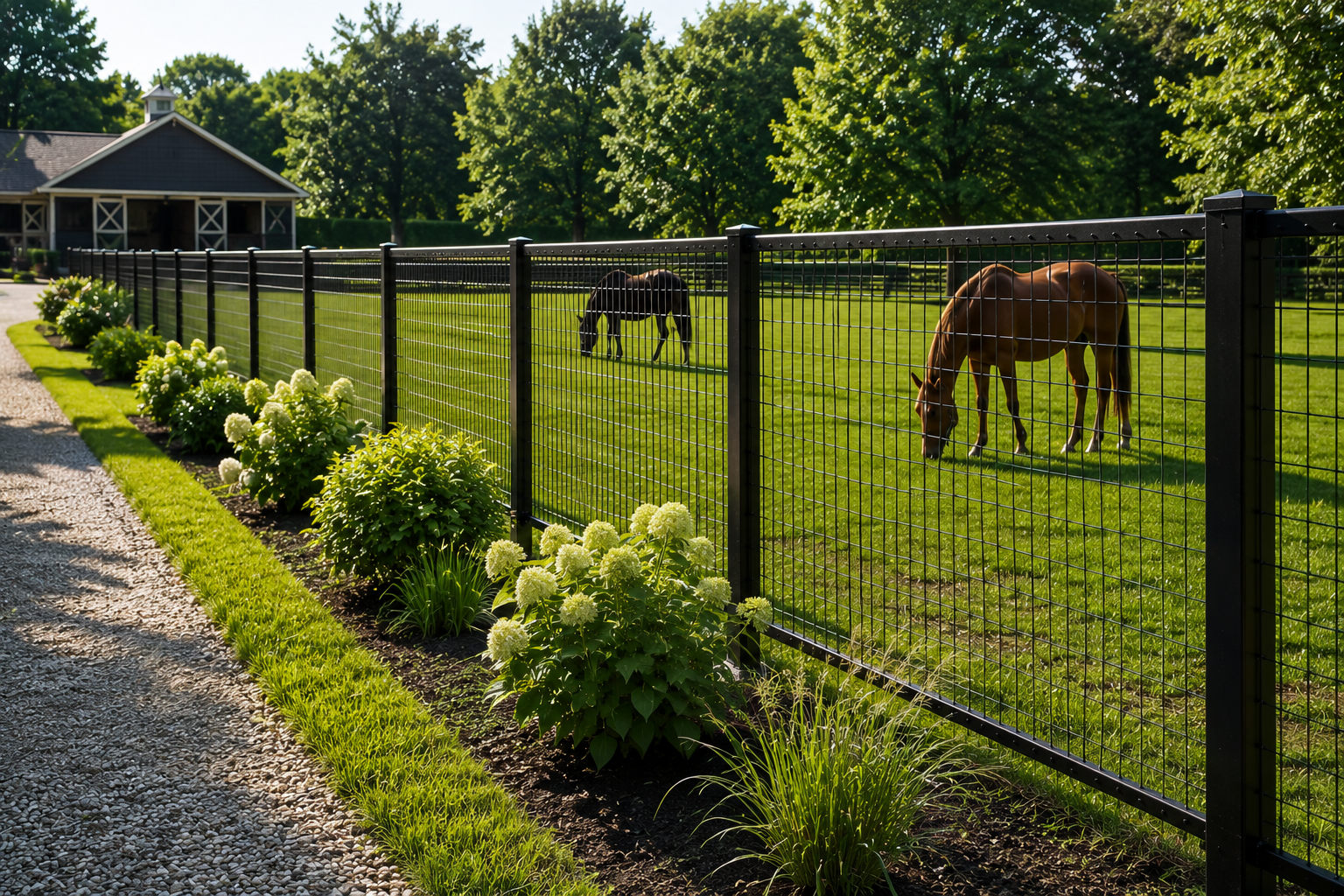
Welded wire, woven field fence and no-climb horse wire, stretched tight on posts set below the frost line. The most economical fence we build, and one of the longest lasting when it's installed right.

Wire Fencing, Done Properly
Cheap to buy. Expensive to do wrong.
Wire is the workhorse of Central Kentucky fencing. It disappears into the landscape, covers long runs for less than any other material, and keeps dogs, goats, horses or deer where they belong. The catch is that a roll of wire is only as good as the posts, the bracing and the tension behind it. A wire fence that sags in year two wasn't a wire problem. It was an installation problem.
Chafin Fence installs welded wire, woven field fence and no-climb horse wire across Lexington, Fayette County and the surrounding Bluegrass counties. We size the gauge and mesh to what the fence has to hold, set posts below the frost line, build proper H-brace corners, and stretch every run with a come-along so it stays drum-tight through Kentucky freeze-thaw.
See all farm fencingWire Fence Types
Four wire systems, one right answer for your property.
Pick the tab that matches what you're keeping in (or out). Each one is built differently, and the differences matter.
Best for: yards, gardens, dog runs, poultry, light perimeters
Welded Wire
A grid of galvanized wires spot-welded at every intersection. The welds hold the mesh perfectly square, so it looks clean, installs fast and stays flat on straight runs. It's the right choice when the fence has to keep a dog in or a deer out, not stand up to a 1,200-pound animal leaning on it.
- Mesh2x3 or 2x4 in.
- Gauge14 to 12.5
- Height4, 5 or 6 ft
- FinishGalvanized or black vinyl-coated
Best for: cattle, goats, sheep, mixed pastures, property perimeters
Woven Wire (Field Fence)
Horizontal wires knotted or hinged to the verticals instead of welded, with the spacing graduated tighter toward the ground so lambs, kids and calves can't slip under. Because the joints flex, the mesh absorbs an animal pushing into it and springs back instead of popping a weld. This is the fence for working livestock.
- MeshGraduated 3 to 7 in.
- Gauge12.5 high-tensile
- Height39, 47 or 49 in.
- KnotHinge-joint or fixed-knot
Best for: horses, foals, ponies, dog and horse shared paddocks
2x4 No-Climb Horse Wire
A woven mesh with 2-inch by 4-inch openings: too small for a hoof to push through, too small for a horse to get a foothold and climb. Paired with a top board or a sight line it becomes the safest wire fence there is for equine properties, and the standard we install on Bluegrass horse farms that don't want four-board along every line.
- Mesh2 × 4 in.
- Gauge12.5 galvanized
- Height5 ft standard
- TopBoard rail or electric strand
Best for: front pastures, driveways, anywhere the fence is seen
Wire With a Board Top Rail
Any of the three wire systems above, capped with a treated or painted 1x6 top board. The board gives horses and cattle a visible line so they don't run into the wire, stiffens the top edge against animals leaning over it, and gives a wire fence the finished look of board fence at a fraction of the price. The most common combination we build on Woodford, Bourbon and Scott County farms.
- Board1×6 treated, paint or stain optional
- PostsTreated 4-5 in. round or 4×4
- Spacing8 ft on centers
- Height4.5 to 5 ft finished
Welded vs Woven
The question we get on every wire estimate.
They look similar on the roll. They behave very differently on the fence line.
| Consideration | Welded Wire | Woven Wire / No-Climb |
|---|---|---|
| How the joints are made | Spot-welded at every crossing | Knotted or hinged, wire wraps wire |
| Under animal pressure | Welds can break, then the panel sags | Flexes and springs back |
| Large livestock (cattle, horses) | Not recommended | Yes, the standard choice |
| Dogs, poultry, gardens, yards | Yes, clean and rigid | Yes, but usually more fence than you need |
| Look on the line | Uniform square grid, very tidy | Graduated spacing, farm look |
| Uneven or rolling ground | Rigid mesh fights the contour | Follows grade easily |
| Rust resistance | Galvanized before or after weld; vinyl-coated available | Class 3 galvanized high-tensile |
| Cost per foot | Lowest of the wire systems | Slightly higher, still well under board or vinyl |
Best Uses
Where wire fence earns its keep.
Backyards & Dog Runs
Four or five foot welded wire on treated posts keeps dogs in without blocking the view. Black vinyl-coated wire nearly disappears against trees.
Welded · 4 to 5 ftGardens & Orchards
Six-foot welded wire is the deer fence that actually works in Fayette County, and the 2x3 mesh stops rabbits at the bottom.
Welded · 6 ftPastures & Perimeters
Woven field fence on 8-foot post centers with H-braced corners covers long boundary runs for cattle, goats and sheep at the lowest cost per acre.
Woven · 47 to 49 in.Horse Paddocks
2x4 no-climb with a top board is the safe, sightly wire system for equine properties that don't want four-board on every line.
No-climb · 5 ft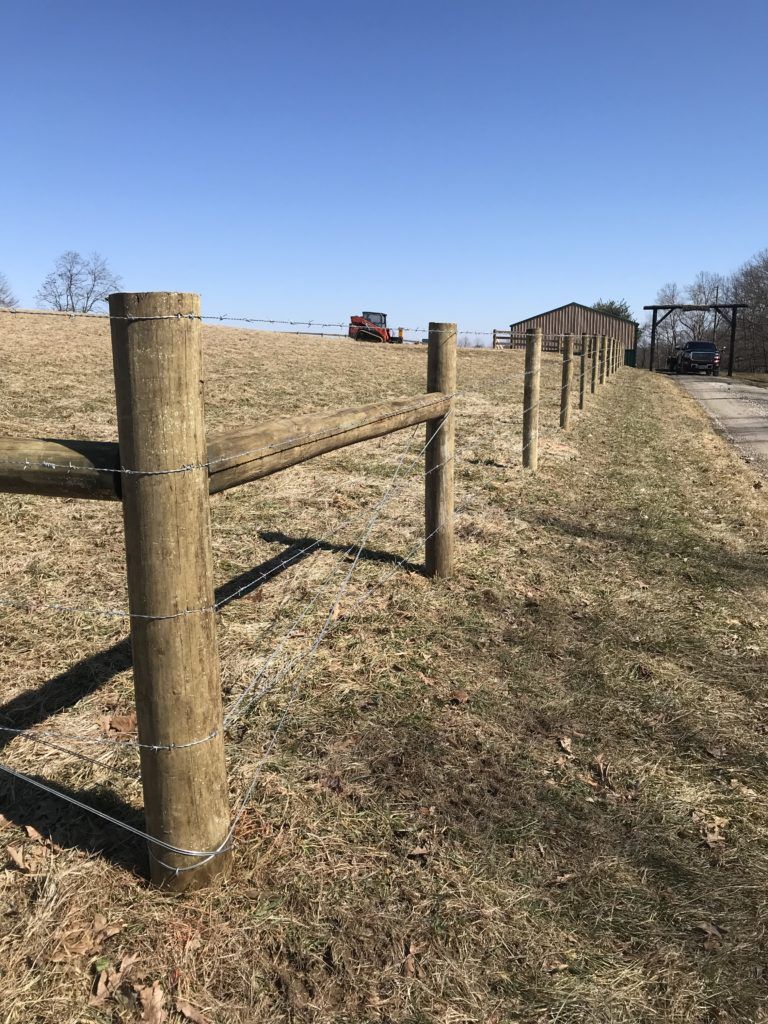 H-brace corner · same bracing on every wire system
What Makes a Wire Fence Last
Five things we don't skip.
- Posts below the frost lineTreated wood or galvanized steel line posts set deep enough that Kentucky freeze-thaw can't heave them, in concrete where the ground calls for it.
- H-brace corners and endsEvery corner, end and gate post gets a braced assembly. That's what the wire pulls against; without it the whole run loosens.
- Stretched, not stapled slackEach run is tensioned with a stretcher bar and come-along before it's fastened, so it stays tight instead of bellying between posts.
- Wire on the animal sideMesh goes on the inside of the posts on livestock fence so pressure pushes it into the post, not off it.
- Gates hung to swing trueFarm and walk gates on their own braced posts with adjustable hinges, so they still latch after the ground moves.
Our Process
From the first call to the last staple.
We walk the line with you
What are you keeping in or out, where does the ground rise and fall, where do gates make sense. Free, no obligation.
Wire type, gauge, height, posts
We recommend welded, woven or no-climb based on the animals and the terrain, and write a firm quote with the spec spelled out.
Kentucky 811 before we dig
Utility locates on every job, plus a check of setbacks, HOA rules or sight lines if the fence fronts a road.
The part that decides how long it lasts
Corners and ends braced first, line posts set to depth, gate posts on their own footing.
Tensioned run by run
Wire stretched tight, stapled or clipped on the animal side, top board or top strand added where the spec calls for it.
Every post, every gate, with you
Final inspection together, and the 5-Year Craftsmanship Guarantee in writing.

Chafin Fence LLC is a BBB Accredited Business, licensed and insured across Central Kentucky. Every wire fence we install carries our 5-Year Craftsmanship Guarantee: if a brace loosens or a run sags because of our work, we come back and make it right.
Wire Fence FAQ
Questions about welded and woven wire.
Welded wire is a grid of wires spot-welded at every intersection, so it holds a rigid, square shape and looks clean and uniform. Woven wire (field fence) is knotted or hinged at the joints instead of welded, which lets the mesh flex under pressure and spring back. Welded wire is the better choice for gardens, dog runs, yards and light-duty perimeters; woven wire is the better choice where livestock will lean, push or rub on the fence.
For cattle, horses and goats, no. A welded joint can pop when a large animal pushes into it, and once a few welds break the panel sags. Welded wire works well for poultry, rabbits, small dogs and garden protection. For horses we install 2x4 no-climb woven wire, and for cattle we install woven field fence or high-tensile wire.
Residential and garden welded wire usually runs 14 to 16 gauge with a 2x3 or 2x4 inch mesh. Heavier duty applications use 12.5 or 11 gauge. For horse fencing, no-climb woven wire is typically 12.5 gauge with a 2x4 mesh so a hoof cannot get through. We match gauge and mesh to what the fence has to hold back, and we can walk you through the options at the estimate.
Four feet is the most common height for yards, gardens and small dogs. Five feet is standard for horse no-climb wire and for larger dogs, and six feet is used for deer exclusion around gardens and orchards. Fayette County and most surrounding counties allow residential fences up to six feet in a back yard without a variance, and taller fences in agricultural zones. We confirm the local rule for your address before we quote.
Galvanized welded or woven wire on properly set posts lasts 15 to 25 years in Central Kentucky, and vinyl-coated wire lasts longer because the coating keeps moisture off the steel. The wire usually outlives the posts, so post material and depth matter most: we set treated wood or galvanized steel posts below the frost line so the fence stays tight through freeze-thaw cycles.
Every wire fence is quoted after we walk the property. The price depends on total linear footage, wire type and gauge, fence height, post material and spacing, whether you add a board top rail, gate count and terrain. Wire fence is one of the most economical systems we install, and we'll give you a firm written quote after a free on-site visit. Call (859) 552-8763 to schedule.
In Lexington-Fayette, residential fences up to six feet in a rear or side yard generally do not require a building permit, though front-yard height limits, corner sight-triangle rules and HOA covenants still apply. Agricultural wire fencing on farm land is typically exempt from permitting. Kentucky 811 utility locates are required before any post holes are dug, and we handle that as part of every job.
Ready for a wire fence that stays tight?
Free on-site estimates across Lexington and Central Kentucky. We'll walk the line, recommend the right wire, and hand you a firm written quote, no obligation.